Monday to Friday, I work in software engineering. The weekend though is usually all about football. As a fan, I’m irrational — but as a leader, I can’t afford to be.
My team is West Bromwich Albion and we play in the second tier of the English professional football pyramid, aka The Championship. We’ve had better times, but in recent years we’ve slipped into mediocrity and have struggled to mount a real attempt to make it back to the riches of the Premier League. Surprisingly, the emotional rollercoaster of watching football at The Hawthorns (our home stadium) has taught me more about my day job than I expected.
When results aren’t going our way on the pitch, everyone has an opinion. The formation is wrong. That player doesn’t care. The manager is clueless. When I’m watching some of the most mediocre football of my life, I won’t lie, my reaction is exactly the same. We judge the team on outcomes and we want to see passion, commitment, and wins. And when we don’t get those things, well, we start to point fingers at individuals. And more often than not, those fingers point at the manager.
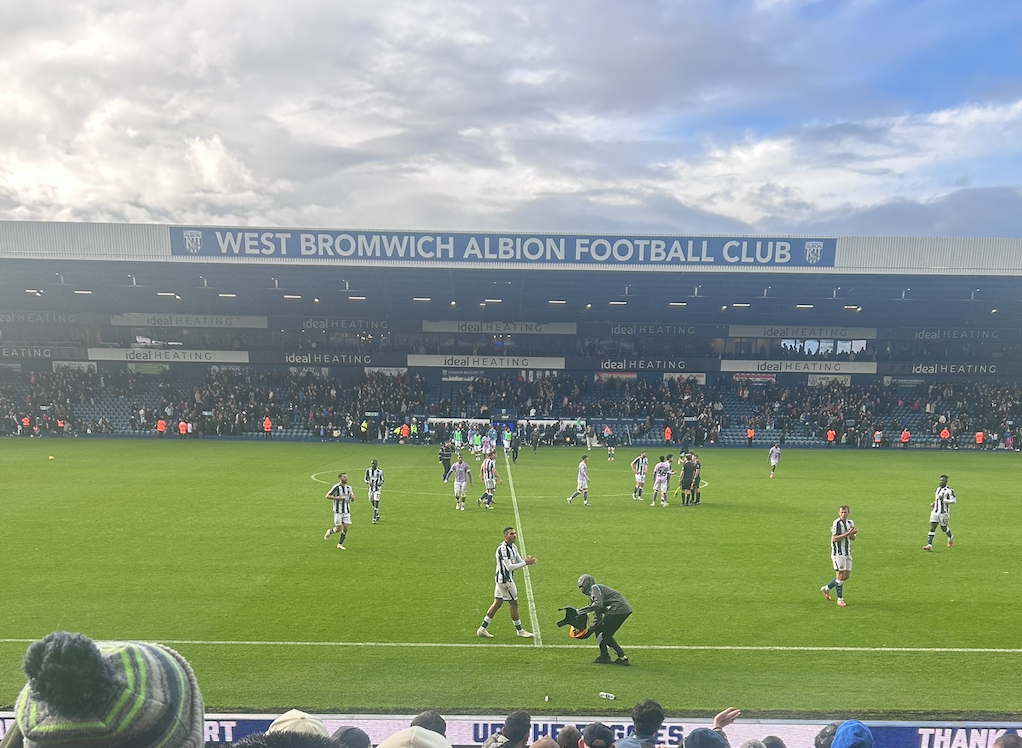
A few weeks ago we were playing a home game and I took the photo below after we’d just drew 0-0 to a team who are rock bottom of the league (sorry Sheffield Wednesday fans). I was a bit late with my snap but the photo shows Karlan Grant, one of our players, just after he finished having an argument with a fan in the stands. I don’t know what was said, but what I do know is that a) he’s frustrated enough to bite back to criticism from the stands and b) there were 3 or 4 of his teammates running towards him to drag him away. For me there are some positives to take from that — he cares egnough to bite, and his teammates care enough to at least steer him away from getting involved further.
In my day job I’ve learned that building a team, especially one operating at high velocity with high stakes, is rarely as simple as assembling a team of competent professionals and leaving them to it. I’ve also learnt that it’s wise to deeply understand and then be hard on the problem, rather than immediately on the individual. The same goes for the manager.
More often than not, the issue isn’t competence (though yes, sometimes it is). The problems generally lie elsewhere — and my main message in this post is that in football, just like in software engineering, not everything is as it may seem…
🫥 The invisible game
From the stands, we don’t see the training ground. We don’t see the personal issues a player is carrying, the tactical instruction they’ve been given, or the quiet lack of confidence rippling through the dressing room after a few bad results (we’ve just hit 8 consecutive away defeats so I bet the staff coach journey home this weekend was fun).
It is exactly the same in engineering. However — when an engineering squad misses a deadline or a platform migration stalls, the first thing I ask is “what are the factors contributing to this?” before making knee-jerk reaction changes. In football however, we jumpimmediately to ask “why aren’t they working harder?” or “sack the manager!” after a few bad results (hi Ryan Mason 👋).
This is where the invisible side of the game comes in:
- Fear or flow? Is the team paralysed by fear of breaking production, or are they safe to take calculated risks?
- Do they actually believe in what they’re doing? (e.g. do they see the impact their efforts will lead to and do they influence/have autonomy over the methods to take them there?)
- Do they have a manager that inspires them to do better (e.g. are they learning and growing as a result of their leadership?)
🧘 Belief is a multiplier
West Brom can’t buy success by buying the best players and the best manager. We don’t have the money and we’re not a particularly exciting proposition for the top players in the game. In order to succeed we have to be greater than the sum of our parts — we have to have belief we can be better. Now I have no idea whether this team have belief or not as I’m not there behind the scenes, but in my job, I know that belief is a multiplier regardless of the company — and if we want to succeed, we’ve got a better chance with belief than without it.
When a team believes in the mission, they understand the outcomes they’re working towards, and they trust their manager has their back, they play with their heads up. They take calculated risks. They cover for each other’s mistakes rather than pointing fingers. They share ownership over problems.
When that belief is gone (e.g. when the dressing room is lost), it doesn’t matter how talented your senior engineers or your star players are. You get slow decision-making, a lack of cohesion, and a culture of “that’s not my job.” You get less optimal outcomes, and that’s then when scruity turns to individuals. Trust me — I watched West Brom when they were managed by Tony Pulis and it was the worst football I’ve seen in my life, but I could suffer it as the outcomes (for most of his tenure) were good.
This is exactly the time we should be looking to deeply understand the contributors to the problem before we call the players out.
😗 The final whistle
Engineering, like football, is a results business. We are here to ship, to scale, and to win. But you don’t get results by luck. You get them by obsessing over culture in the dressing room or the office and the human systems that lead us to success.
So here’s my advice. By all means, scream at the team and the manager on Saturday afternoon — but when the score looks bad, don’t just look at the players. Look at the belief, the culture — and when you’re back to work in the new year, remember you’re the one capable of changing the game 🤝